Selling your business in the next few years? If you’re thinking about a future sale, there are three key things you need to focus on right now to get the best value and make your business more appealing to potential buyers.

1. Address the Risks

First and foremost, buyers care about risk, not profit.

When potential investors or buyers look at your business, they’re not just buying into your profits, they’re buying into your risk. They want to know that the business is low-risk, whether that risk is internal or external.

Your job is to minimise those risks.

If you know there are potential issues (whether it’s a supplier problem, legal risk, or any operational bottlenecks), fix them now. Buyers don’t want to inherit a problem, they want something that runs smoothly, efficiently, and predictably.

So, tackle the potential risks head-on. Have solutions in place to show that when they buy, they’re stepping into a secure, stable business. No surprises.

2. Build Standard Operating Procedures (SOPs)

Next up, let’s talk about standard operating procedures (SOPs).

When a buyer comes in, they want to know if your business can run without you. If you’re the “key person” running everything, that’s a huge red flag.

The more your business can function without you, the more valuable it becomes.

Create clear processes for everything. The more streamlined your operations are, the more attractive your business becomes to a buyer. When you can show that the business doesn’t rely on your daily involvement, you’ve built something that’s scalable and transferable, and buyers will pay more for that.

3. Get a Business Valuation

And finally, if you don’t have a business valuation, how do you even know what your business is worth?

Without understanding the value of your business, how can you plan for growth or figure out what areas need attention? You can’t.

A business valuation is essential. It shows you exactly what drives your value and where you can improve. If you don’t have one, you’re essentially flying blind.

And here’s the thing—your valuation doesn’t have to be where you want it to be right now. But knowing where you stand means you can make the changes needed to increase that number. Whether it’s increasing your margins, improving your customer retention, or tightening your processes, a valuation gives you a clear target to aim for.

Ready to Sell? Let’s Get Your Business in Shape

If you’re planning to sell your business and want to ensure you get top dollar, start with these three steps:

  1. Minimise risks and have solutions ready.

  2. Build and document your SOPs to make the business run without you.

  3. Get a professional business valuation and work towards improving it.

If you need help with any of these areas, reach out today.

Let’s talk about how we can increase the value of your business and help you plan for a profitable exit.

Book a free consultation 

Contact us today.

Scaling a business from zero to eight figures within just 15 months isn’t something that happens by chance. It’s a process, one that I follow every time I’m working with a business, whether I’m an owner, investor, advisor, or coach. And the first step? Getting a solid understanding of unit economics.

The Power of Unit Economics

When we started scaling that business, I went straight to the numbers.
Gross profit margin and cost per acquisition (CPA) were the first things I looked at.

I didn’t care about anything else until I understood those key figures. If the unit economics were solid and scalable, I knew we had a formula to push forward. If they weren’t, we would adjust, fix the gaps, and make it work.

Once those numbers were dialed in, we went aggressive with marketing.

Why?
Because understanding the numbers gave us the confidence to scale. We knew that as long as we kept our CPA and lifetime value (LTV) in line, growth wasn’t just a hope, it was a certainty.

Using Data to Drive Growth

Here’s the kicker: the real reason we scaled so quickly wasn’t because of endless ad campaigns. It was because we had data.

With that data, we could forecast a full 12 months ahead.
We understood how to leverage our cash flow and profitability to fuel growth.

It wasn’t about having millions in the bank.
It was about using the money effectively, not sitting on it, but reinvesting it to continue scaling. We got the business to a point where we weren’t just growing fast, we were growing sustainably.

The Key to Scaling Fast

If you want to scale your business quickly, you have to understand your numbers.
And I’m not talking about just tracking revenue or sales. I’m talking about unit economics.

You need to understand:

  • Cost per acquisition (CPA): How much it costs you to bring in a customer.

  • Lifetime value (LTV): How much that customer will bring you over time.

These two numbers are the foundation of your scaling plan. When you understand them, you can adjust and pivot your business in real-time to make smarter decisions.

It’s about knowing what works and what doesn’t. You test and refine, you scale based on what’s driving your growth, and you make sure your marketing, sales, and retention efforts are all aligned with your unit economics.

Start Scaling Smarter Today

If you’re ready to scale, you can’t afford to guess. You need to know your unit economics and use that data to drive decisions. It’s about ensuring that every lead you bring in, every customer you acquire, and every product or service you sell is driving real, sustainable growth.

If you need help figuring out what’s missing in your unit economics or how to adjust your strategy for better scalability, reach out to us at New Wave Accounting and Business Advisory. We’ll work with you to assess your business, identify opportunities, and build a 12-month cash flow plan that gets you on track for sustained growth.

Scaling a business isn’t about luck. It’s about understanding the numbers, making smart decisions, and using data to guide your growth.

Let’s get your business there. Reach out today.

Book a free consultation 

Contact us today.

If you’re not tracking your Cost per Acquisition (CPA) and Lifetime Value (LTV), you’re essentially flying blind when it comes to scaling your business.

Let’s get this straight: 90% of businesses I meet don’t know what it costs them to acquire a customer and have no idea what that customer is worth over time.

So, how do you expect to scale efficiently if you don’t know the basic numbers that drive your growth?

Cost per Acquisition: What’s It Really Cost You?

It’s easy to think that if you just spend more on ads or sales, you’ll get more customers and increase your revenue. But that’s not always the case.

What matters is understanding exactly what it costs to bring in a customer. It’s not just about the cost of the product or service. You need to account for:

  • Ad spend (e.g., Facebook, Google, etc.)

  • Sales time and onboarding

  • Marketing costs and merchant fees

When you understand your CPA, you can make smart decisions about how much to spend on marketing and advertising.

Lifetime Value: The True Worth of Each Customer

Next, it’s crucial to know how much each customer is worth to your business in the long term.

You need to calculate how much revenue you’ll generate from each customer over the entire relationship. Are they just a one-time purchase, or will they buy again and again?

By understanding LTV, you can shift your mindset from worrying about the immediate sale to thinking about building long-term value.

How These Two Metrics Unlock Real Growth

When you combine CPA and LTV, you gain powerful insights into how scalable your business truly is. With these two metrics in hand, you’ll have a clear idea of what it costs to acquire a customer and how much profit they’ll bring over time.

Here’s the beauty of it:

When you know that for every $1 you spend on marketing, you get $1,000 back, scaling your business becomes a strategic, data-driven decision.

You can confidently pour money into marketing knowing exactly how much you’ll get in return. It’s no longer a gamble—it’s a proven formula.

Why You Can’t Afford to Ignore Unit Economics

If you’re not tracking your CPA and LTV, you’re operating in the dark. You might be growing, but you’re probably leaving money on the table or even losing money.

These numbers aren’t just nice-to-know—they’re essential for making smart, informed decisions about how to scale your business profitably.

Ready to Scale with Confidence?

If you want to take control of your business’s growth, start by understanding your unit economics. Track your CPA and LTV, and use them to make data-backed decisions that fuel your scalability and profitability.

At New Wave Accounting and Business Advisory, we help businesses like yours optimise their numbers so that scaling becomes a clear, actionable strategy.

Reach out today, and let’s unlock the potential of your business together.

Book a free consultation 

Contact us today.

Why More Sales Aren’t Always Better

Most businesses don’t fail because they don’t have enough sales.

They struggle because they are making more sales, and losing money on every single one.

Read that again.

I see it all the time, business owners throwing thousands into Facebook ads, Meta campaigns, influencers, email sequences, all trying to get more traffic, more leads, more customers.

But here is the truth:

If you are losing money on every sale, more sales just speed up the problem.

More noise, more spend, more stress, and no real profit.

This is not a marketing problem.
It is a unit economics problem.

What Unit Economics Really Means

Unit economics means knowing exactly what it costs you to deliver your product or service, from start to finish.

And I am not just talking about the wholesale price or your hourly rate.

I am talking about everything it takes to get that product or service into your customer’s hands.

If you run an e-commerce store, your costs are not just the $30 wholesale price.

It is $30, plus GST, plus import duties, plus 3PL fees, plus warehousing, plus shipping, plus merchant fees, plus Shopify charges, plus team costs, plus customer service, plus marketing and ad spend.

That 40 percent markup you added to cover your bases, is probably not enough.

And now you could be running at a loss without realising it.

How to Fix It and Scale Smarter

Service business owners, this applies to you too.

Maybe you offer consulting, design, massage therapy or bookkeeping.

Your hourly rate might look good on paper.

But did you factor in the cost to acquire that client?

Discovery calls, admin time, follow-ups, staff wages, software fees?

If not, you could be missing out on serious profit.

Here is the mindset shift:

Do not guess your margin, know it.

Before you spend another dollar on Meta ads, Google Ads or the latest marketing trend, get your numbers right.

Know your cost per acquisition.

Know your lifetime value.

Know what you are actually making on every sale after all the hidden costs.

Scaling with broken margins is like driving faster in the wrong direction.

It feels exciting.

It looks busy.

But it will not get you where you want to go.

Want to scale? Start with the math.

Fix your margins.

Then press the gas.

Are you profitable on every sale?

If you are not sure you are profitable on every sale, it is time to fix that.

Reach out to the New Wave team today.

Let us fix your margins and build a business that grows the right way.

Book a free consultation 

Contact us today.

In business, there’s one crucial aspect that many overlook: business valuation. Sure, everyone talks about profitability, but what about the true worth of your business in the market? How much of your profitability should be reinvested to drive the actual value of your business as an asset?

Let me give you an example from the real estate industry to illustrate this concept.

If I could go back, I would have spent more time understanding the core financial levers that matter. These levers aren’t just some theoretical concept—they are the very things that allow a business to run profitably and sustainably.

The Profitability vs. Valuation Dilemma

In real estate, particularly with property management businesses, the value of your business is often determined by a multiple of your annual revenue—typically three to three and a half times, depending on the strength of your operations. This means, if your property management business generates $1 million in annual revenue, its market value could be anywhere between $3 million and $3.5 million.

But here’s where many business owners get stuck—they focus purely on profitability. They chase the numbers that show how much they are making this year, but neglect the fact that business value isn’t just about profits. It’s about growth, expansion, and sustainable development.

A Real-Life Example: Focusing on Profitability Without Growing Business Value

I worked with a client in the real estate space who was making $1 million in annual profit. Great, right? But here’s the catch: for years, they were consistently making the same profit without increasing their revenue base. Essentially, while they were bringing in the same amount of money, the value of their business wasn’t moving.

Their business was valued at three times their annual revenue, so at that $1 million revenue mark, the value of their business remained stagnant. In other words, despite their profitability, their business valuation wasn’t growing.

Shifting Focus: Reinvesting to Grow Both Profit and Business Value

I sat down with them and asked two key questions:

  1. How much of that $1 million in profit do they need personally?
  2. What could they do to reinvest some of that profitability back into the business to drive growth and increase the value of the business itself?

Once they evaluated these questions, they realised that a portion of their profits could be reinvested into marketing and hiring a business development manager (BDM). This move would not only help them grow profitability but would also increase their revenue base, which directly impacted the value of the business.

Understanding unit economics and cash flow isn’t just about keeping your business afloat—it’s about creating the space to reach your bigger objectives. When you focus on these core metrics, you’re not just building a business; you’re building a business that works for you.

The Results: Profit and Value Both Increase

The following year, the results spoke for themselves. They maintained their $1 million in profit—but their annual recurring revenue from property management increased by $150,000. As a result, the value of the business increased by $450,000.

Why is this significant? It’s not just about having more cash flow coming in today; it’s about future value. The more you grow the underlying value of your business, the higher the potential multiple you can achieve when it comes time to sell or evaluate your company’s worth.

The Takeaway: Building Profitability AND Business Value

While profitability is essential, it’s only one piece of the puzzle. To build a high-value business, you need to focus on growth, reinvestment, and scaling in ways that increase both profit and business valuation. The smartest businesses are those that balance the two.

If you’re chasing profits, ask yourself: How much of that profit can I reinvest to increase the long-term value of my business?

In this case, reinvesting in marketing and a business development team helped turn a stable profit into real growth, which boosted both revenue and the future valuation of the business.

In the end, it’s all about building a business that is sustainable and valuable—one that works for you today and grows in worth for the future.

Frequently Asked Questions

How do I calculate the value of my business?

The value of a business is often determined by a multiple of your annual revenue, especially in industries like real estate property management. Typically, this multiple ranges from three to three and a half times your revenue, depending on the strength of your operations and growth prospects. To get a more accurate valuation, you should consider factors like profitability, revenue growth, and how well your business can scale in the future.

Why should I reinvest profitability into growing my business value?

Reinvesting profitability back into your business allows you to increase its value over time. By focusing on growth areas like marketing or hiring a business development manager (BDM), you increase your revenue base, which directly impacts the market value of your business. Reinvestment ensures that your business not only stays profitable but also grows in value, which is key for long-term success and higher valuation when it comes time to sell or expand.

What’s the relationship between profit and business valuation?

Profit and business valuation are closely related, but profit alone won’t grow your business’s value. To increase your business’s market worth, you need to focus on both profitability and growth. While profitability shows current success, the value of the business is determined by its long-term growth potential and how effectively it can scale. Focusing on reinvestment and sustainable development helps achieve a higher valuation, giving you a stronger position when it comes time to sell or expand.

realestatecasestudyimage2

Ready to Simplify Your E-commerce Finances?

Whether you’re looking to optimise your pricing strategy, improve client retention, or better understand your unit economics – we’re here to help. Book a free consultation with our expert team at New Wave Accounting & Business Advisory, dedicated to supporting businesses across Australia.

Contact us today.

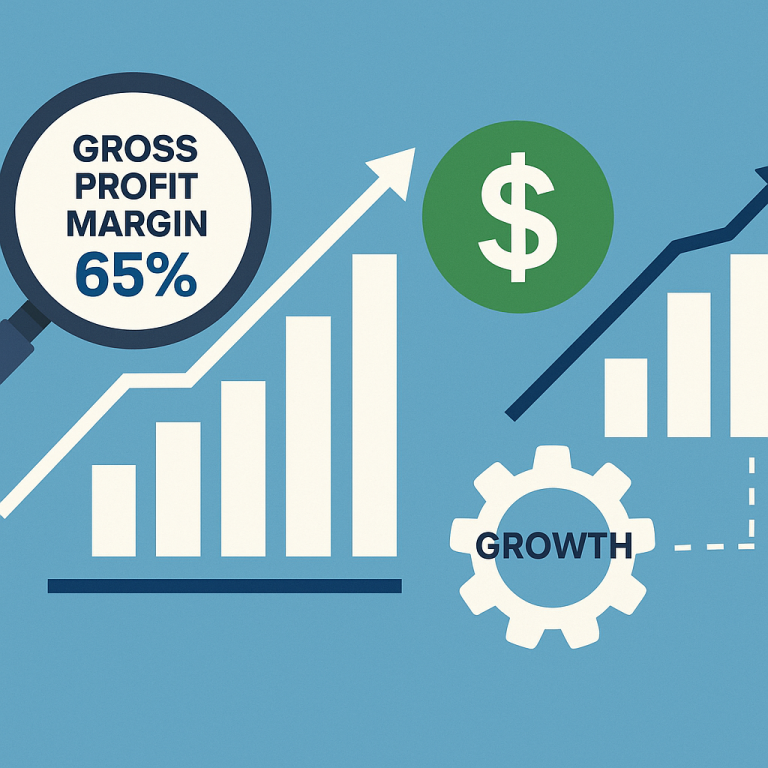
To all the new business owners out there: stop focusing on client acquisition and the constant drive to increase your revenue until you’ve actually looked at whether your gross profit margins are in a place where they’re scalable.

Let me explain what I mean by that.

The Common Pitfall of Focusing on Revenue

I’ve encountered countless businesses where the number one goal is to constantly drive revenue, get new clients, pump out ads, and push for growth in any way possible. They’re focusing on the top line—how much revenue they can generate—hoping that profit and cash flow will follow.

But here’s the catch: if your gross profit margin isn’t healthy, increasing your revenue is just going to make things worse in the long run.

What Is Gross Profit Margin and Why Does It Matter?

Simply put, your gross profit margin is the difference between your revenue and the direct costs it takes to acquire and deliver your product or service. It’s what’s left after you’ve covered the direct costs like marketing, production, and delivery.

If you’re pushing for revenue growth without a solid margin, you’re heading into dangerous territory. Think about it—razor-thin margins put you into a zone of risk. More sales, but not enough left over to cover the business’s costs or reinvest for growth? That’s a recipe for disaster.

Start with the Basics: Understand Your Margins

Before you even think about scaling or getting more customers, you need to understand your numbers—specifically, your gross profit margin. If you don’t have a healthy margin in place, the business will face problems as soon as you start pushing for more growth.

I recommend taking the time to sit down, identify what your margin looks like, and then strategise on ways to increase it. How can you extract more value out of your existing customers? How can you raise prices on products and services without losing customers?

Increasing Margins: The Key to Scaling

Once you’ve identified and optimised your margins, then you can start thinking about scaling—acquiring more customers, selling more products, and increasing revenue. But don’t skip the crucial step of getting the margin right first.

It’s like laying a strong foundation before you start building. Without it, everything else is built on shaky ground.

The Bottom Line: Build for Long-Term Success

If you’re starting a business or you’ve already got one running, take a step back and assess where you are with your gross profit margins. This should be your first priority before you push for growth and scale.

If you need help drilling down on the figures and understanding where things are going right (or wrong), business coaching can provide you with the clarity you need to strategise and move forward effectively.

Once your profit margins are in a good place, then—and only then—should you focus on scaling your business for long-term growth.

Frequently Asked Questions

How do I know if my gross profit margin is strong enough to scale?

A strong gross profit margin gives you the breathing room to reinvest in your business without running on fumes. As a guide, you want a margin that not only covers your direct costs but also leaves enough to support overheads, reinvestment, and profit. If your margin is below 30%, it’s time to review your pricing, costs, or delivery model. We can help you assess the numbers and build a margin that supports long-term, scalable growth.

I’m bringing in a lot of revenue—why don’t I have more money in the bank?

Revenue is just the top line—it doesn’t reflect what you keep. If your direct costs, like materials, marketing, or service delivery, are too high, your gross profit shrinks. That means you’re working harder, but not getting ahead. We help business owners drill down into where the money is going and identify how to improve margin without sacrificing quality or customer value.

What are some practical ways to increase my profit margins?

Start by analysing your pricing—are you charging enough for the value you deliver? Then look at your delivery costs—can you streamline or renegotiate supplier terms? Finally, consider upselling, bundling, or increasing retention with existing customers. Small tweaks can create big gains. We work closely with clients to implement these margin-boosting strategies in a way that fits their model and market.

ChatGPT Image Apr 23 2025 02 54 55 PM

Ready to Simplify Your E-commerce Finances?

Whether you’re looking to optimise your pricing strategy, improve client retention, or better understand your unit economics – we’re here to help. Book a free consultation with our expert team at New Wave Accounting & Business Advisory, dedicated to supporting businesses across Australia.

Contact us today.

When I sit down with a new client, one of the first things I do is assess the overall health of their business. Without this essential step, any strategy or growth plan would be built on shaky ground. The key to understanding how well a business is performing—and identifying areas for improvement—starts with a clear financial review.

Here’s how I approach the process.

Step One: Review the Profit and Loss Statement

The first document I bring up is the profit and loss (P&L) statement. I focus on the last 12 months, but pay special attention to the most recent months—ideally the last three months. The P&L gives an immediate snapshot of how the business is performing. The key questions I ask are:

  • Is revenue increasing or decreasing?
  • Are the margins stabilised and at a level where the business can scale?
  • What does profitability look like, and are there any major changes in overheads?

Understanding these elements helps me gauge the financial health of the business and whether it’s on track for growth. If revenues are flat or margins are shrinking, we need to dive deeper into why that’s happening.

Step Two: Assess the Balance Sheet and Cash Flow

Once we’ve looked at the P&L, the next step is to assess the balance sheet. This is where I look at the financial position of the business over the last 12 months, focusing on:

  • Cash flow: Is cash consistently coming in or are there spikes and dips?
  • Short-term and long-term debts: Are there any outstanding debts that could present a risk to the business’s sustainability?

Strong cash flow is a vital indicator of business health. If cash flow is weak, even a profitable business can face operational challenges. Debt management is also key—too much debt can be a drag on future growth, while a manageable level allows for reinvestment.

Step Three: Identify Risks and Opportunities

After reviewing the financials, it’s time to identify potential risks—such as increasing overheads or rising debt—and opportunities for improvement. By comparing the P&L and balance sheet, I can get a clear picture of the financial state of the business. This information gives us the clarity needed to make informed decisions.

It’s also at this stage where I can start forecasting with the business owner. Once we have a clear understanding of the numbers, we can start to map out a plan to either maintain or improve the business’s performance in terms of profitability and cash flow.

Step Four: Translate Financial Insights into Action

Understanding the financials is crucial, but what happens next is where the real work begins. After gathering all the necessary data, I sit down with the business owner and conceptualise a strategy. The goal is to identify the top three things the business can do in the next quarter to improve profitability and cash flow. This could include:

  • Cutting unnecessary costs
  • Improving pricing strategies
  • Increasing lead generation or conversion rates

I believe that without an underlying understanding of your business’s unit economics, it’s impossible to make informed decisions about where the business is headed. When owners are only thinking day-to-day, they miss the big picture—and fail to adjust course before things go wrong.

Final Word: Make Financials a Priority

If I were a business owner, I would recommend meeting regularly with your accountant or business coach to thoroughly review the profit and loss statement, balance sheet, and unit economics. This financial understanding will give you the insight needed to make decisions that drive growth and profitability.

Aim to assess your business regularly and take action on the top areas that will impact profitability and cash flow. Small, consistent improvements over time can result in substantial growth and a more sustainable business.

Frequently Asked Questions

How often should I review my financials with my accountant or advisor?

At a minimum, we recommend quarterly reviews, but if your business is growing quickly or facing challenges, a monthly check-in can make a huge difference. Regular financial reviews help you spot trends, identify risks early, and stay ahead of cash flow issues before they become major problems. It’s not just about tracking numbers—it’s about staying in control of your strategy.

What’s the first sign that my business might be heading for financial trouble?

The biggest red flag we see is inconsistent or declining cash flow. You might still be profitable on paper, but if cash isn’t flowing, it puts stress on your operations. Other warning signs include shrinking margins, increased reliance on short-term debt, or unexplained jumps in overheads. A thorough review of your profit and loss and balance sheet will reveal where the leaks are

I’m profitable—why do I still feel like my business is stuck?

Profit is just one piece of the puzzle. You can be profitable and still lack clarity, scalability, or direction. If you’re not regularly assessing your business performance and aligning it with your long-term goals, growth can stall. We help business owners map out a path that ties financial results to real outcomes—like better systems, stronger margins, and time back in your day.

ChatGPT Image Apr 23 2025 02 38 10 PM

Ready to Simplify Your E-commerce Finances?

Whether you’re looking to optimise your pricing strategy, improve client retention, or better understand your unit economics – we’re here to help. Book a free consultation with our expert team at New Wave Accounting & Business Advisory, dedicated to supporting businesses across Australia.

Contact us today.

When it comes to pricing your services, there’s a key question every business owner should ask: How did you come up with the price you’re offering?

You might be thinking, “I just chose a price I felt was reasonable.” If that’s the case, it’s time to dive deeper into your pricing strategy. Without a clear, intentional strategy in place, you’re essentially leaving money on the table, and the opportunity for gross profit could be lost.

The Importance of a Pricing Strategy

Most small businesses start by setting prices based on gut feeling. But that’s not enough if you want to truly scale. To maximise your profitability, I encourage you to create a pricing matrix. Start by gathering input from peers—whether it’s friends, family, or colleagues within your industry. This can help you determine the optimal price for your services.

Pricing should never be random. Instead, it should be a well-thought-out decision based on what you want to achieve. The key is aligning your price with the value you’re delivering.

Competing on Value, Not Price

It’s tempting to compete on price, especially when you’re trying to attract more clients. But here’s the thing—competing on price rarely works for small businesses. The larger, more established players can afford to lower their prices because they do so at scale. They have the resources to provide high-quality services at lower rates.

For small businesses, pricing too low can put you at risk. Your margins will be razor thin, and even the smallest mistake could wipe out your profits. Plus, pricing too low may attract clients who are only looking for the cheapest deal, rather than those who truly value what you offer.

Think about it—do you want customers who are looking for the cheapest option? Or do you want clients who are willing to pay for quality and value? Typically, businesses that compete solely on price don’t last long because they don’t offer enough value to justify their existence.

Finding the Sweet Spot in Pricing

The goal is to find the middle ground—a price that reflects the value you offer without alienating potential customers because the price is too high. There is a balance between charging what’s fair for the value you provide, while also ensuring that your margins are large enough to cover your costs and support your growth.

It’s a process of testing and adjusting. As you gain more experience, you’ll figure out where that sweet spot lies.

The Importance of Value-Based Pricing

When I started my accounting firm, I made the classic mistake of setting prices too low. Like many new businesses, I took on every client I could to simply survive. But over time, I realised that pricing too low didn’t help me deliver the best service.

Once I raised my prices, I found that I could:

  • Provide better service by giving clients more time and attention.

  • Increase margins, giving myself more room to deliver higher quality work.

  • Avoid burnout by not overworking to make ends meet.

Pricing is not just about surviving—it’s about delivering value to your clients while maintaining the margins needed to grow. When you price based on the value you provide, your gross profit will improve significantly, and your business will thrive.

The Bottom Line: Price for Profitability and Growth

In the beginning, it’s natural to undercharge as you try to establish your business. But as you grow, remember that pricing isn’t just about surviving—it’s about thriving. By pricing based on the value you deliver and ensuring you have enough margin to scale, your profitability will increase, and your business will be on a trajectory for long-term growth.

So, take a step back and evaluate your pricing strategy. Ask yourself: Is your price aligned with the value you provide? If not, it’s time to adjust.

Frequently Asked Questions

How do I know if my pricing is right for my business?

Pricing should never be based on guesswork. It’s important to align your price with the value you provide to your clients, not just the costs of delivering the service. To determine if your pricing is right, I recommend creating a pricing matrix and gathering feedback from peers or industry colleagues. You also want to ensure your price covers all costs—direct and indirect—while leaving room for a healthy profit margin. Over time, as you test and adjust, you’ll find the sweet spot where pricing reflects both value and profitability.

How can I avoid competing solely on price?

Competing on price is a dangerous game, especially for small businesses. Larger competitors can afford to lower their prices because they have the scale to do so profitably. For small businesses, pricing too low can erode your margins and attract clients who value cost over quality. Instead, compete on value. Focus on what makes your service unique and how it delivers superior outcomes for your clients. This will allow you to price based on the value you offer, not just what others charge.

What should I do if I realise I’ve been undercharging for my services?

First, recognise that you’re not alone—many business owners start off undercharging to build their customer base or stay competitive. But once you’ve established your business, it’s important to adjust your pricing to reflect the value you’re delivering. This may involve gradually increasing your prices and communicating the added value to your clients. When you raise your prices to match the value you provide, it will allow you to improve service quality, increase margins, and avoid burnout, all while positioning your business for sustainable growth.

Pricing Image

Ready to Simplify Your E-commerce Finances?

Whether you’re looking to optimise your pricing strategy, improve client retention, or better understand your unit economics – we’re here to help. Book a free consultation with our expert team at New Wave Accounting & Business Advisory, dedicated to supporting businesses across Australia.

Contact us today.

Understanding the Core Metrics for Sustainable Growth

When it comes to scaling a business efficiently and profitably, two numbers matter more than most: lifetime value and cost per acquisition.

Every business I come across—whether I am coaching, launching or acquiring—gets the same treatment. I look straight at these two metrics. If they do not stack up, we go deep and figure out why. Because once you understand these numbers, you unlock the roadmap to sustainable and scalable growth.

What is Lifetime Value?

Lifetime value (LTV) tells you how much revenue, after costs, a single client will generate over the entire course of their relationship with your business. It includes revenue from every product or service they buy, minus direct costs like onboarding, delivery and marketing.

If you are selling a product or service, the question is not what you make today. The question is how much value that client brings over time, and what it costs to keep delivering that value.

The insight: High lifetime value gives you room to invest. It is a sign that your clients stay longer, spend more, and are receiving real value.

What is Cost per Acquisition?

Cost per acquisition (CPA) is the total cost to convert a lead into a paying client. This includes your ad spend, plus any other resources—sales calls, marketing time, systems—that help bring someone on board.

This is where efficiency lives. If your cost to acquire is low and your lifetime value is high, you have a business model you can scale with confidence.

The insight: A scalable business is one where every dollar spent on acquisition returns multiple dollars in value.

Conversion is in the Speed

Next, we tackled lead conversion. Their cost per acquisition was high. After reviewing their process, it became obvious that the problem was response time. Leads were coming in, but the team was too slow to respond. In today’s market, if you are not following up with a lead within ten minutes, you are almost certainly losing business.

We introduced a system that guaranteed fast responses and clearly communicated the benefits of each service. The result was a higher conversion rate and lower acquisition cost.

The insight: You may not need more leads. You might just need to convert the ones you already have, more effectively and more efficiently.

Lifetime Value is the Key

Finally, we looked at lifetime value. Instead of clients booking one session at a time, we encouraged them to purchase in packages—such as ten massages or a twelve-month wellness plan. This increased upfront revenue and created a predictable income stream.

It also built stronger client relationships because the focus shifted from single transactions to long-term results and value.

The insight: When you deliver long-term value, you create long-term revenue.

The Result

Within just three months, this business experienced:

  • A noticeable increase in profitability
  • Healthier and more consistent cash flow
  • Improved client retention
  • A team that finally understood the financial mechanics of the business

By aligning Shopify with Xero and automating transaction tracking, one client significantly reduced manual errors and uncovered $6,200 in missed GST credits across two quarters.

Here Is The Takeaway

Unit economics is not optional

 It is the difference between guessing and growing with confidence.

If you are a business owner, become intimate with your numbers. Know your gross profit margin. Understand your cost to acquire a client. Measure how long your clients stay and how much they spend.

Once you see the system clearly, you can optimise it. And when you optimise the right levers, profitability improves fast.

Frequently Asked Questions

How do I calculate the Lifetime Value (LTV) of my customers?

To calculate LTV, you need to track how much revenue an average customer generates over their relationship with your business. This includes repeat purchases and any other ongoing spend, minus the costs associated with acquiring and delivering the product or service. We can help you establish this number by analysing your customer data and providing a clear picture of long-term profitability.

What can I do if my Cost per Acquisition (CPA) is too high?

If your CPA is too high, it means you’re spending too much to acquire each customer. To reduce CPA, we recommend optimising your marketing channels, improving lead conversion rates, and refining your sales strategies. We can help analyse where your acquisition costs are leaking and provide practical steps to lower them, ensuring your business can scale more profitably.

How can I improve my LTV to CPA ratio to scale more effectively?

Improving your LTV to CPA ratio requires focusing on increasing customer retention, raising prices where appropriate, and enhancing customer lifetime engagement. By balancing your LTV and CPA, we help you strategise ways to increase profitability. This could involve refining your sales processes, improving customer experience, and using smarter marketing tactics. We work with you to boost your margins and help your business grow with confidence.

Mastering LV and CPA

Ready to Simplify Your E-commerce Finances?

Whether you’re looking to optimise your pricing strategy, improve client retention, or better understand your unit economics – we’re here to help. Book a free consultation with our expert team at New Wave Accounting & Business Advisory, dedicated to supporting businesses across Australia.

Contact us today.

Newwave Accounting

Contact Us

8:00am-5:00pm Monday - Thursday
8:30am-2:00pm Fridays

Book a FREE Web Meeting

Download your FREE copy of my book

101 Strategies for Business Owners To Save Tax

Save Tax helps business owners, entrepreneurs and commercial adventurers:
  • Pay only the tax that they need to
  • Find the right people to help you save tax
  • Simplify and demystify tax obligations

At the end of the day, and by the end of this book, you will have an understanding of how and why you should invest in minimising your tax and making the most of your business.

Where should I send a free copy of my book?

bki book 1 big
ui share dino
ui share shapes

Share This

Select your desired option below to share a direct link
to this page. Your friends or family will thank you later.