Buying a business instead of building one can be the fastest way to grow. You skip the hardest years and get customers, staff, systems and cash flow from day one. But trust the wrong set of books, or pick the wrong structure, and you can hand the seller your upside on day one.
In Episode 32 of Business Uncut, Reuben walks through what to check before you sign, how the deal structure changes your tax bill, and the traps that catch buyers on the Gold Coast and right across Queensland. The checking process has a name: due diligence. It just means checking everything properly before you commit.
The problem: the profit number in the sales document
Most buyers fall in love with the profit number in the information memorandum, the glossy sales document the broker sends you. That number is the seller’s best foot forward. Not a lie, necessarily, but definitely not the whole story.
A hypothetical example
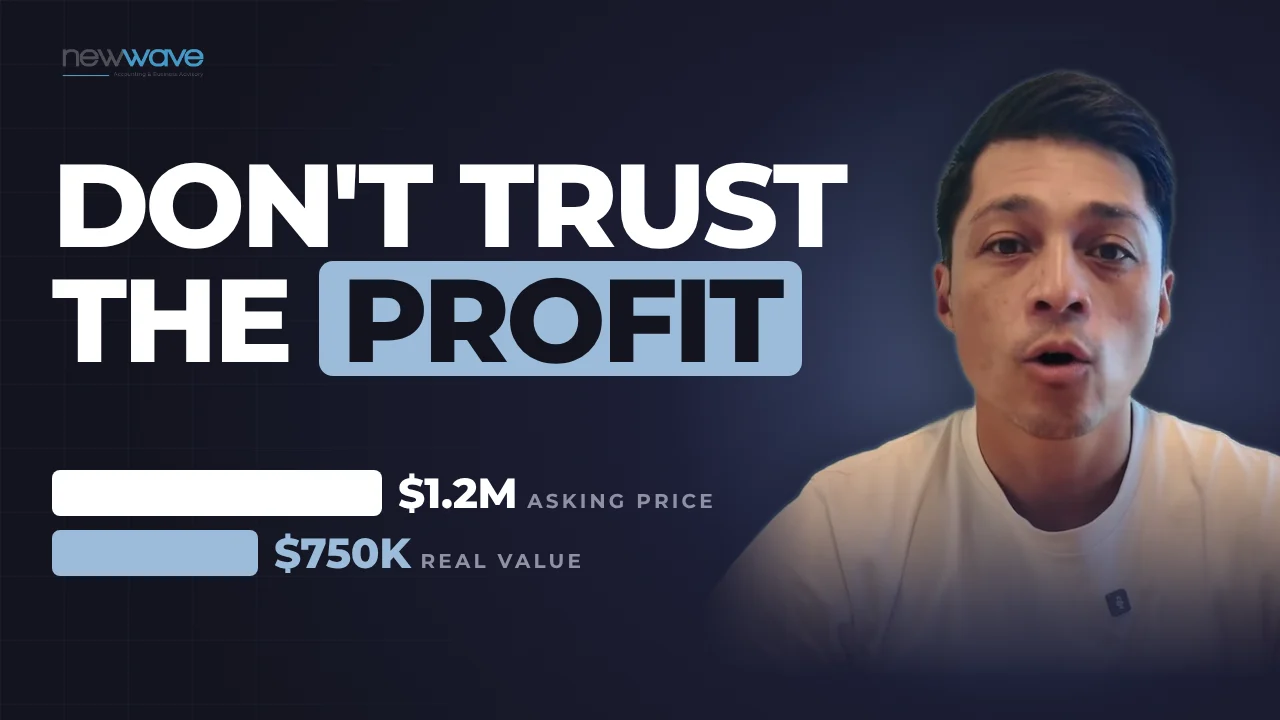
Let’s say, hypothetically, you’re looking at a trade services business. The memorandum says it makes $400K a year in profit and the asking price is $1.2M. That’s a multiple of three (the price divided by the yearly profit).
Sounds fair, until you dig in. The owner works 60 hours a week and pays himself nothing on paper. To replace him with a manager, you might be up for around $150K a year. So the real profit, what’s left after you pay someone to do his job, is more like $250K. At three times that, the business is worth $750K, not $1.2M.
That’s $450K of overpayment on one line item, before you’ve even looked at the tax. And with interest rates where they are, most buyers will be borrowing, so every dollar you overpay is a dollar you’re paying interest on for years. The price is the biggest decision in the deal.
Step 1: Rebuild the real profit yourself
Sellers use add-backs: costs they say won’t continue once you own the business. Some are legit, like a one-off legal bill. Some are wishful thinking. Hypothetically, if the seller adds back his wife’s wage, ask who’s doing her job tomorrow.
Get three years of financials, tax returns and BAS (your business activity statement, the regular GST report to the tax office). Then match the lot to the bank statements.
The principle: trust the bank, not the spreadsheet.
Step 2: Decide asset or share purchase
In an asset purchase, you buy the bits you want: equipment, stock, the brand and goodwill (the value of the name, the customers and the reputation). The seller keeps the company and its history.
In a share purchase, you buy the company itself, warts and all. Old tax debts, underpaid wages or late super come with it. Under Payday Super, from 1 July 2026 super has to reach the fund within seven business days of payday, so check the business has been keeping up. If you do go the share route, you’ll want warranties (the seller’s written promises about the business) and indemnities (the seller pays you back if those promises turn out to be wrong).
Sellers often push for a share sale for their own tax reasons. From 1 July 2027, for individuals, trusts and partnerships, the 50 per cent CGT discount is replaced by indexation, which adjusts the cost for inflation, plus a 30 per cent minimum tax on gains. The small business CGT concessions stay. Expect some sellers to want a deal done before then. That urgency can help you negotiate, just don’t let it rush your checks. We cover the change in CGT Changes 2027: 4 Checks Before You Sell Your Business.
The principle: in a share deal, you’re buying the past.
Step 3: Get the GST going concern right
A going concern is a business sold as a working, operating business. If the sale qualifies, there’s no GST on the price. The conditions:
- You’re both registered for GST
- You agree in writing
- The seller supplies everything you need to keep it running
- The seller keeps running it right up to settlement
Miss one and it falls over. Hypothetically, on an $800K asset deal, losing the exemption means 10 per cent GST, $80K, that you’ve got to fund at settlement. You might claim it back later, but that’s borrowed money in the meantime.
The principle: get it in the contract, clearly.
Step 4: Cost the Queensland duty
Duty is the state government’s tax on transfers, and in Queensland it isn’t just a property thing. Depending on what’s in the deal, business assets can be dutiable too. And buying shares in a company that owns land can trigger landholder duty, which is basically duty as if you’d bought the land yourself.
The principle: know the duty number before you agree the price.
Step 5: Pick the right buying entity
Company, trust or a mix. The government has proposed a minimum 30 per cent tax on discretionary trusts (family trusts where the trustee chooses who gets the income) from 1 July 2028. It is not law yet. It was announced in the May Budget and the draft is still being worked through. But if you’re holding this business for ten years, factor it in. Our articles on trust vs company and the signs your structure has outgrown you go deeper.
The principle: structure for the next decade, not the next tax return.
The traps that catch smart buyers
- The lease. If the business runs from a site, the lease can be half the value. Is there enough time left on it, and will the landlord agree to transfer it to you? No lease, no business.
- Staff entitlements. If employees come across, their annual leave and long service leave often come with them. That’s a real cost, so make sure it’s reflected in the price.
- One big customer. If one client is a third of the revenue, you’re not really buying a business. You’re buying a relationship, and relationships don’t always transfer.
- Falling in love before you’ve done the numbers. Make every offer subject to due diligence and finance, so you can walk away if the checks don’t stack up.
Your one action this week
Before you sign anything, ask the seller for three years of tax returns, BAS and bank statements, and rebuild the profit yourself. If they won’t hand them over, you’ve got your answer.
Frequently asked questions
What should I check before buying a business?
Start with the real profit: three years of financials, tax returns and BAS, matched to the bank statements, with every add-back tested. Then look at the deal structure, the GST treatment, any duty, the buying entity, and the traps: the lease, staff entitlements and customer concentration.
Is it better to buy the assets or the shares of a business?
It depends on the deal. In an asset purchase you choose what you buy and the seller keeps the company’s history. In a share purchase you take the company as it is, including any old tax debts, underpaid wages or late super, so warranties and indemnities matter. Get advice on your situation.
Do you pay GST when you buy a business?
Not if the sale qualifies as a GST going concern: both parties registered for GST, agreed in writing, the seller supplies everything needed to keep it running and keeps running it until settlement. If any condition is missed, GST can apply to the price.
Is there stamp duty on buying a business in Queensland?
It can apply. Depending on what’s in the deal, business assets can be dutiable, and buying shares in a company that owns land can trigger landholder duty. Know the duty number before you agree the price.
If you’re weighing up a purchase, or you’ve already got one in your sights, book a strategy call with New Wave and we’ll talk through the structure with you before you commit. You can also listen to Business Uncut on Spotify.
General information only, not personal tax, legal or financial advice. Figures are hypothetical examples. Talk to your adviser about your own situation.